

The stock market, a complex tapestry of numbers and emotions, is influenced by a myriad of factors. Among these, the curious case of the “Sell Rosh Hashanah, Buy Yom Kippur” adage stands out, blending religious observance with financial strategy. But what’s the story behind it, and does empirical evidence support this age-old trading wisdom?
Historical Roots and the Eisenhower Connection
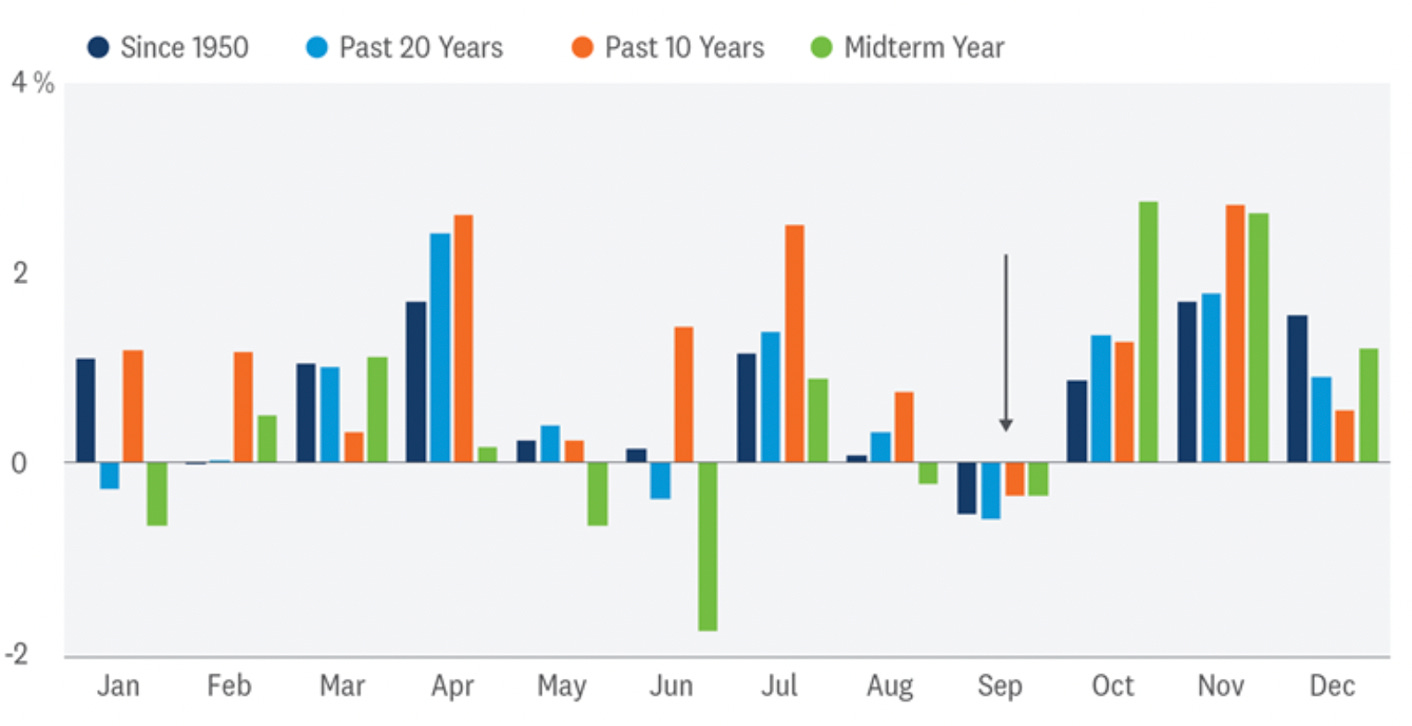
The phrase “Sell Rosh Hashanah, Buy Yom Kippur” has been part of trading folklore for decades. Its origins can be traced back to the belief that September, during which these holidays typically fall, is a tumultuous month for stocks. This belief is not unfounded. Historical data suggests that September has often been a challenging month for the stock market, with traders being advised to stay out of the market during this period to avoid potential losses.
The adage gained significant traction in 1955, a year that would forever be etched in trading history. On the eve of Rosh Hashanah, the Dow Jones Industrial Average closed at 483.66. A week later, it had risen by 0.78%. However, the following weekend brought shocking news: President Dwight Eisenhower suffered a heart attack. As Yom Kippur commenced, the markets reacted violently. The Dow plummeted by 6.54%, marking its second-largest single-day point drop at the time. Traders who heeded the advice to sell on Rosh Hashanah were spared from this drastic downturn.
The 2023 Perspective and Market Dynamics
In 2023, the “Sell Rosh Hashanah, Buy Yom Kippur” strategy made a dramatic return, with the commencement of the Jewish New Year coinciding with September’s quadruple witch expiration, a rare event that only occurs four times a year. This alignment added an extra layer of volatility to the market. Historical data from 2022 showed that adhering to this seasonal pattern would have resulted in significant rewards for investors.
Moreover, Yom Kippur, while not an official market holiday, is observed by many in the New York area, especially within the Jewish community. Their absence can dampen trading activity as positions are squared ahead of the holiday.
Empirical Evidence: A Deep Dive
While the saying has historical and religious significance, its relevance in today’s trading world is still a topic of discussion. Some traders swear by it, while others see it as a relic of the past. However, with the days of the week in 2023 aligning similarly to 1955, and with events like a triple-witch, UAW strike, and an FOMC meeting occurring around the same time, the adage might still hold some weight.
Recent studies have delved into the empirical evidence behind this phenomenon. One such study from NYU Stern examined the S&P 500 and FTSE 100 daily rates of return during Jewish holidays and found that the average returns for the holiday values compared to the controls never differed by more than around two-thirds of a percent. Interestingly, Yom Kippur showed a significant rise in daily return variance compared to both the S&P 500 and the FTSE, indicating higher volatility on this day.
Additionally, the study underscored that trading volumes were notably reduced on both Rosh Hashanah and Yom Kippur compared to regular trading days, pointing to the diminished activity during these sacred observances. Given the introspective nature of these holidays, many traders likely choose to distance themselves from the market’s frenetic pace.
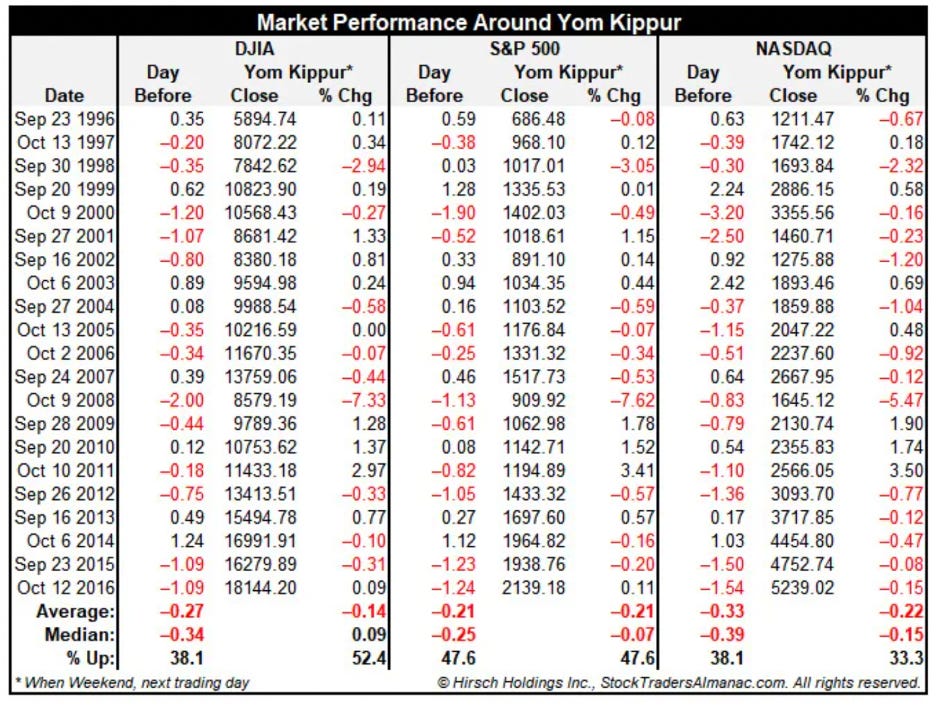
Similarly, according to 2017 data, in the previous 21 year, the day before Yom Kippur has often been weak for the market. The DJIA, for instance, advanced only 38.1% of the time, recording an average loss of 0.27%. Similarly, NASDAQ and S&P 500 have shown bearish tendencies around this time, further emphasizing the potential influence of this religious observance on market dynamics.
Conclusion
The stock market’s movements are shaped by both analytical data and the intricacies of human behavior. The saying “Sell Rosh Hashanah, Buy Yom Kippur” exemplifies this interplay, weaving together historical trends with deep-rooted cultural and emotional influences. Regardless of whether investors adhere to this maxim, it underscores the market’s inherent volatility and the diverse forces that propel its direction.
Disclaimer: The information provided in this article, including any references to financial data, market performance, and trading strategies, is for informational purposes only and should not be considered as investment advice or a recommendation to buy or sell any type of securities. The author is not responsible for any investment decisions made based on the information provided in this article. Investors should always conduct their own research and consult with a professional financial advisor before making any investment decisions. Past performance is not indicative of future results, and no representation or warranty, express or implied, is made regarding future performance.